Everyday Cycling PinUps

By Sarah Ripplinger

These cyclists from Chicago aren’t your average PinUp girls. They’re racers, commuters and recreational riders whose striking images will be laid bare in the Thought You Knew (TyK) 2011 calendar, the third in the series.

“TyK shows exactly how sexy an active lifestyle of biking makes a lady,” said TyK founder and producer Alexis Finch. “Yes! We have asses and thighs! We have calves that challenge the widest of boots! And we are an amazingly sexy bunch.”

TyK takes women cyclists from the streets of Chicago and gives them a chance to show another side of themselves. Freed from assumptions and stereotypes, these cyclists get to define what their version of sexy is. The calendar explores who they are as individuals and cyclists.

Said Finch: “the end result looks amazing. It proves that it doesn’t take a model to make a sexy photo, while at the same time letting every lady who participates realize what an exhausting job modeling is, and how unreal all those photos they see really are.”

There’s a men’s calendar, too.

“After much clamor and demand we created a venue for guys to do their part for The Chicago Women’s Health Center,” said Finch. “Last year we presented them as SuperHeroes. This year, we’re taking it back and going totally 1980s with the guys reimagined as classic 1980s TV shows.”

The 2010 TyK calendar was distributed to cities across the United States and grabbed attention and wall space in places as far flung as Shanghai, Toronto and London.

One hundred percent of TyK calendar sales goes to the Chicago Women’s Health Center (CWHC), a nonprofit health center that has been providing affordable health care and education to women and trans people since 1975. CWHC’s mission is to respect each individual’s unique relationship with her body and sexuality, and recognize the importance this plays in providing quality health care. Most notably, CWHC provides services to all clients, regardless of ability to pay.

“I think it’s important with a project like this to give back to women,” said Finch. “We’re talking about ownership of our bodies here, and Chicago Women’s Health Center, through education and health care, is doing that every day.”

TyK is made possible thanks to the work of volunteers who donate their time to website design, calendar layout, photography and hair and makeup.

As for whether there will be a calendar next year, Finch said: “As of right now? Yes.”

Next year, Finch would also like to make it possible for women across the US to get involved.

“There are a few who are on the ‘hot list’ from NY, Boston, Philly, Portland and Milwaukee as possible pinups for next year,” she said. “But with scheduling and funds it will be a tricky thing to make it happen.”

“One way or another, it’s going to be hot.”

TyK’s Gala-Gallery Launch party is scheduled for Friday, November 19 from 6-10 p.m. at the Chicago Coworking Space. Calendars will be on sale, as well as art prints of all the PinUps and 80s TV Stars. Complimentary cocktails will be served.

Calendars are available through the thoughtyouknew.us website.

Find out more about TyK by visiting their Facebook page.

Originally published on momentummag.com.
A Hands-on Experience at Brooks England

By Sarah Ripplinger

Birmingham, England-Brooks Bike Ride
BicycleImages.com for Brooks Saddles
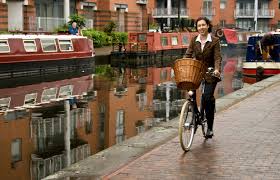
Momentum Editor Sarah Ripplinger riding along a canal in Birmingham, UK.

Colorful rows of bike seats line long racks. Bins filled to the top with all manner of shiny and polished flyers, side rods and seat noses checker the room. Loud booms, bangs and whizzing sounds fill the air as workers operate machines — some at least 50 years old — that churn out springs and sheets of metal or stamp nameplates and holes.

This is the Brooks England Ltd. factory where the well-known leather saddle and bike bag manufacturer produces comfortable and durable accessories and posterior supports for customers around the world.

Taking the saddles from flat leather mats to seats fit for the open road is a team effort, and the workers at the factory showed how it’s done to the close to 50 journalists from around the world who gathered there for a tour on June 8, 2010.

The factory, located in Smethwick, West Midlands, UK, is where it all happens: from cutting out the pattern of the saddle, to molding the shape of the seat and securing it with copper rivets.

Established in 1866, Brooks has a long history of fashioning saddles that presently cater to the sensibilities of traditionalists, everyday cyclists and performance riders alike.

The leather is sourced from farms in England where the cows roam in open pastures. Exposure to the elements makes their hides thicker and produces the required five-millimeter-thick leather Brooks demands for its saddles. The toughness of the leather is why Brooks saddles can last a lifetime.

After the saddle pattern is stamped out — cowhides used to make the leather seats come from the back and rump of a cow — the spare leather is used for accessories, such as leather grips and the ends of handlebars.

It’s a hands-on process: from soaking the leather to make it pliable, to molding it into the proper shape, smoothing the edges of the leather and affixing it to metal rails and springs. And it’s refreshing to see that Brooks is still producing quality saddles in this traditional manner.

A Very Merry Tweed Ride and Picnic

Our day wouldn’t have been complete without a cycle through the English countryside in our finest riding attire. The 2010 Extraordinary Brooks Picnic ride was a 17-mile jaunt from the Brooks factory, along the beautiful network of canals in Birmingham and over to Blackwell Court, the former Brooks family home.

It poured rain that morning, so many of us — including me — were furnished with Brooks’s new John Boultbee Oxford Rain Capes. The capes, which have reflective material woven into the fabric in certain places, kept my upper half perfectly dry and quite toasty. The cape comes with magnetic ties at the front that you hook over your handlebars — producing a tent that protects your legs and feet.

Inclement weather aside, we shared a lot of laughs, a couple of bumps and repairs and a lot of stories from our respective homes. The surrounding environment was a marvel to look at, with old brick and stone houses — some with thatched roofs — fields with grazing sheep and cows and brick lanes. Plus, I got to ride on the left-hand-side of the road, which was a thrilling experience along the narrow streets still dominated by the personal automobile.

I met some wonderful people from Brooks and other bicycling publications and got a taste of England, including fish and chips and bangers and mash. The ride and factory tour were certainly highlights of the trip. Not only good excuses to dress up, act the refined cyclist and test out some Brooks gear — including their saddles — for an afternoon, the trip was a reminder of the origins of cycling.

Bikes with pedals — known as velocipedes (fast feet) — have been ridden in Europe since the 1860s. While much has changed in the world of bikes since then, some things remain the same, such as handmade saddles and the warmth and moisture wicking properties of a good tweed jacket.

Originally published in Momentum magazine.

Cycling’s Future

It is true that the young will inherit the earth. Whether we have cycling-friendly cities or gridlocked superhighways in the future is largely determined by the choices we make and the knowledge we impart to youngsters today.

There are so many benefits that children who cycle from an early age experience, as their parents can attest, including better health, a sense of community and overall wellbeing. Kids who bike learn to be independent and gain a sense of autonomy as they operate their own mode of transportation. They experience their communities and the outdoors while getting fresh air and exercise, which is more important in the age of digital technology and climate change than ever before.

I have fond memories of biking with my family as a child along the urban streets of Guelph, Ontario. Gazing up at the branches of trees passing above me, I felt like I was flying. Biking gave me transportation freedom: I could get to school, friends’ places and, when I got older, downtown on weekends, all without the help of my parents. I was free to choose my route, which improved my sense of direction and made me more familiar with street names and the geographical layout of my city.

Many families want their kids to experience the joys of riding. Some, however, have concerns about letting their kids bike alone to school or a friend’s place. Long-time Momentum contributor, Chris Keam, explores some of these concerns in his “Growing Up Velo” story on p. 37.

Statistics show that independent bicycle dealer unit sales of youth bikes – bikes designed specifically for ages 12 and under, including BMX and sub-20-inch wheel bikes – in Canada and the United States have stayed close to the 20 percent mark for the past decade. The number of youth cyclists in the US rose by 4.3 percent between 2007 and 2008, according to National Bicycle Dealers Association (NBDA) figures. Still, some industry experts believe more should be done to attract young riders.

Dave Overgaard, Norcoís bicycle division vice president, told me in a telephone interview that the bicycle industry needs to create bikes that fit kids properly and communities need to build the infrastructure that will encourage more kids to ride.

Robert Jones, statistics program manager for the Bicycle Trade Association of Canada, said key drivers for kids bike sales are cost, parentsí preferences and theft-prevention.

“The things that are working against it (getting more kids on bikes) are parents’ paranoia about allowing their children to get out of their sight and the fact that bikes get stolen.”

More work needs to be done to attract young riders, commented NBDA executive director Fred Clements in a June 2009 Bicycle Retailer and Industry News article. In the same issue, Jay Townley, manager of Gluskin Townley Group, made a plea to the bicycle industry to place a higher value on increasing youth ridership. “[I]f anything, it is even more important in the long-term to get more kids on bikes more often than to get more adults on bikes,î he said. ìOur future depends on it.”

Will communities continue to expand bicycle networks? Will there be plenty of green spaces? Will there be an emphasis on alternative forms of transportation? Will cyclists feel included or excluded? What the future holds comes down to the choices we make today and the lessons we pass on to the ambassadors of tomorrow. Our generation might not be around to cycle the streets 50 or 100 years from now, but our kids and their kids will.

Sarah Ripplinger

Editor, momentum magazine

sarah@momentumplanet.com

Originally published in the Sept/ Oct 2010 issue of Momentum Magazine and on momentummag.com.

Embracing Change

Sarah Ripplinger IconSarah Ripplinger portrait by Terry Sunderland

You may notice a few changes to Momentum – both on the website and in the magazine.

In May 2010, we re-launched momentumplanet.com – our online storehouse of all things Momentum past and present – with the intent to serve you, our readers, better and to share our love of the cycling life with more people. We are in the process of re-populating the new site with earlier content and apologize for any disruption in your ability to access our archived material while we continue updating.

We are also in the process of shifting our regional focus to our website. Our new Community section was designed to facilitate more information-sharing between communities and we invite you to get involved and suggest stories you’d like to see there.

Change has become a driving force in the world of print media. Online platforms and free information-sharing on the Internet have pushed many print publications over or close to the brink.

One of Canada’s media giants, Canwest Global entered into bankruptcy protection in January of this year and magazine newsstand sales in the United States declined 9.1 percent from 2008-2009 and 11.12 percent from 2007-2008, according to the Audit Bureau of Circulation.

Niche publications seem to be the exception. Titles such as Women’s Health, Off-Road Adventures, FamilyFun and People’s StyleWatch are seeing increases in their circulation numbers.

Momentum Magazine has been experiencing both sides of this ever-evolving media coin. On the one hand, the present conditions in the global financial market and the ascendancy of online news and information have forced us to tighten our purse strings, but, at the same time, our print circulation almost doubled between 2009 and 2010 and we are seeing more and more interest in both our niche publication and our mission to create a strong culture of self-propelled people in North America.

Although we have felt the economic hardships, Momentum is still part of the growing trend in magazines. We are adapting to the changing environment while staying focused on our mission to serve our audience by providing useful, informative – and fun – stories.

Our new website will offer community event and business listings. We also have a team of dedicated writers who update our website regularly with important news from self-propelled communities in North America, and occasionally in other parts of the world, and spread the word using social media, such as Twitter and Facebook.

If you would like to join our community news team – contact us! We are providing a space for your community news and stories and we invite you to help us reflect what is really going on around you.

As we move forward with our new online look, we will be fine-tuning and adjusting our content to meet your needs. Please feel free to “Add your thoughts” at the bottom of stories using the comment box or send us an email to let us know how we’re doing.

Each new print edition of Momentum Magazine – only six per year – contains the stories, images and information that we believe should be printed, shared and treasured. Our commitment on that front remains the same.

Keep those spokes spinning,

Sarah Ripplinger

Editor, Momentum Magazine

Originally published in the July/ Aug 2010 issue of Momentum Magazine and on momentummag.com.

Exploring New Territory

Sarah Ripplinger IconSarah Ripplinger portrait by Terry Sunderland

There’s an element of excitement when traveling abroad, or even when taking a new route to work or the grocery store. This experience is particularly special when you are the navigator and primary engine of your voyage. At the end of the day, though, the enjoyment factor of any given trip often depends on what you use to get there.

My excursion to Richmond, Virginia, for the North American Handmade Bicycle Show (February 26-28, 2010) involved a tour around the historic city with some veteran local cyclists. I felt the bumps in the cobblestone streets, the gusts of wind coming off the James River and enjoyed the camaraderie of traveling with a group of like-minded individuals. Similar to our travel story writers, I was exploring a distant land, learning about the local culture and tackling the challenges of the landscape.

That adventure involved a harrowing introduction to a classic 1985 road bike that would have been perfect for someone five inches taller than me – which gave me a deeper appreciation for how much what you ride affects how you feel. In comparison, my most recent adventure with an electric-assist bike was a breeze.

I have several hills to contend with on my trip home. Riding an e-bike, however, I no longer opt to cool my heels on the bus after hoisting my bike onto the front rack, but zip up the longest series of hills on my route with a little help from the electric-assist. Similar to our e-bike riders in this issue’s subculture story, I am testing the waters of one of the newest arrivals in the North American commuter cycling scene. And if China and the Netherlands are any indication of things to come, there are likely to be many more cyclists venturing into e-cycling territory in the future.

In many ways similar to Richmond, VA, urban cycling is starting to get a foothold in Detroit, MI (city feature). Both places have plenty of road space for bicycles – as a result of the removal of some large industrial complexes and decreased or stable population numbers – which has left a lot of room to incorporate bicycle infrastructure. Many barriers will need to be overcome before these cities reach the ranks of “bicycle-friendly,” but the future of cycling in both locations looks bright.

Happy spring cycling,

Sarah Ripplinger

Editor, momentum magazine

sarah@momentumplanet.com

Originally published in the May/ June 2010 issue of Momentum Magazine and on momentummag.com.