A Fresh Start

Momentum Magazine Editor Sarah Ripplinger.

This issue marks a major milestone and turning point for Momentum. We’ve come a long way since our beginnings back in 2001 (see timeline on p. 12). Now, with the publication of the 50th installment of Momentum Magazine, we are debuting a stylish and more mainstream look and feel.

It has been amazing, challenging and rewarding to be with Momentum as we reach this turning point. I am excited about our future and look forward to many more years of evolution and change as we continue to listen and react to what you want to see on our pages. By focusing on the bike lifestyle (see feature on p. 32) as a whole, we are in a better position to deliver the information and resources you need to live happier, saner lives on two wheels. Please share your thoughts about our new content: letters@momentumplanet.com. I look forward to reading your comments.

In this issue, we give you a peek at some of the hottest gear for spring 2011 (p. 46), share tips on preparing for a vacation-by-bike (p. 52), take you to the bike lanes of New York City (p. 39), give you a glimpse into the day of a folding biker (p. 28) and show you how to host your very own bike birthday party (p. 25).

Our new lineup of features and columnists will open up the dialogue on hot button issues, such as ticketing cyclists (p. 21), conservatism and cycling (p. 58) and riding with newborns (p. 26), to name a few.

There is so much to discuss. Our cities are growing and maturing in many different ways, which makes establishing better policies and practices around bike infrastructure and laws of imminent importance. Likewise, we should continue to celebrate the joy and functionality of cycling by showing just how fun and easy it is to ride a bike in your city. This is Momentum’s ongoing quest. I hope you will continue to join us for the ride.

Happy spring cycling,

Sarah Ripplinger

Editor, Momentum Magazine

Originally published in the March/ April 2011 issue of Momentum Magazine and on momentummag.com.
Love Potion Number Nine

Celia Alvarez & Andres Straulino share a post-wedding embrace at the La Diana Cazadora/ Diana the Huntress monument in Mexico City, Mexico.

You know the drill. You’re pedaling along when an attractive cyclist sidles up beside you. Maybe s/he isn’t looking your way, but you notice him/ her. Or maybe s/he’s giving you elevator eyes and pondering whether pointing out your low tire pressure might be a good way to break the ice.

I wonder: Could the act of riding increase one’s chances of finding true love?

In cooler weather, the adrenaline rushes through our veins as we weave through neighborhoods and downtown centers. Could this be the “love potion number nine” of the road? After all, one of the first things people recommend when giving friends advice about finding a partner is: “Get out there, meet new people, get involved in an activity.” People who ride bikes can already check at least two of those recommendations off their lists.

Biking is a solitary affair if you pedal along by yourself. But it doesn’t have to be. There are plenty of opportunities to strike up a conversation at a stoplight or when parking your bike next to an attractive individual (or bike for that matter). Take the opportunity to ask your fellow cyclist questions about his/ her ride, or stylish clothing. A compliment is a great way to spark a new relationship.

If you need more specifics about finding love in the bike lane, contributor John Greenfield has some tips for igniting passion on, beside and straddling the saddle (p. 23). Our BikeStyle (p. 24) feature shows you how you can dress to impress. We also share winter riding tips (p. 18) and gear (p. 36), and explore the world of handmade bikes (p. 28).

So what if the weather is cooler now? All the more reason to heat up your commute.

Sarah Ripplinger

Editor, Momentum Magazine

sarah@momentumplanet.com

Originally published in the Jan/ Feb 2011 issue of Momentum Magazine and on momentummag.com.

Cycling’s Litmus Test

Momentum’s mission is to make cycling accessible to everyone. A big part of that mission involves extending an olive branch to women and families, mainly because there are too few of them behind the handlebars.

During a “Selling to Women Seminar,” I recently attended at Interbike 2010, four panelists: Pam Kruse, owner of Village Biking & Fitness; Elayne Fowler, marketing director of Electra Bicycle Co.; Jeff Selzer, general manager of Palo Alto Bicycles; and Leigh Carter, a senior account executive at Quality Bicycle Products, discussed how bike shop owners and employees can make women feel more welcome. The seminar room was packed with a 60-40 split of women to men, about 12 to 15 percent of whom were bicycle dealers. It was an impressive turnout, but as one panelist later pointed out, the topic of conversation has been kicked to death – it’s time for action.

Despite the fact that women make 85 percent of all consumer buying decisions in the United States, seminar moderator Diane Lees, who owns Hubbub Custom Bicycles in Chesterland, OH, said many shop owners don’t recognize the different needs of their female clientele. The same goes for hiring women. Women make up only 12 to 15 percent of employees in the bike industry, according to Outdoor Industries Women’s Coalition regional communities representative Paula McConnell. Said Selzer: “We’re starved for women in this industry.”

The ratio of female to male cyclists in the bike lane is similarly out of balance. At least twice as many men cycle compared to women in the US. In contrast, 55 percent of cyclists in the Netherlands are women, 49 percent in Germany. Infrastructure plays a key role, along with the perception that cycling is a safe, a healthy and an accessible mode of transportation for everyone, including families. Encouragement also goes a long way.

As the panel of experts at the “Selling to Women Seminar” pointed out, bike shops and their employees should learn to market to women, if they aren’t already. They can employ new approaches to attract female clientele to their stores, such as running basic bike maintenance workshops for women that are taught by a female mechanic and organizing social women-only rides led by women. They can also carry women-specific bikes and accessories – bearing in mind that women like to “shop” and so need to have a selection of products to choose from. Beyond these basic approaches, as Lees put it: “Want to know one way to find out what women want and need? Ask them.”

Getting more women on bikes benefits us all. A survey conducted by the Association of Pedestrian and Bicycling Professionals in the spring of 2010 found that women often shy away from cycling because of safety concerns, such as distracted drivers and a lack of cycling infrastructure. The Women’s Cycling Survey report, published in September of this year, notes that “women from large cities were most receptive to the addition of bike lanes as a means to start/ increase their cycling.” In other words, the better the infrastructure, the more likely it is that women in urban environments will bike. The more women bike, the more they will shop for bicycles and accessories, and demand products that fit their riding style and preferences.

In this issue, we reflect on some of the major events that have shaped cycling culture in North America over the past year. The images on the following pages, including the bike lane photo on page 29, demonstrate how close we are to having multimodal urban centers. The litmus test to determine the success of this movement will boil down to how many of the new converts to transportation cycling are women.

Originally published in the Nov/ Dec 2010 issue of Momentum Magazine and on momentummag.com.

Everyday Cycling PinUps

By Sarah Ripplinger

These cyclists from Chicago aren’t your average PinUp girls. They’re racers, commuters and recreational riders whose striking images will be laid bare in the Thought You Knew (TyK) 2011 calendar, the third in the series.

“TyK shows exactly how sexy an active lifestyle of biking makes a lady,” said TyK founder and producer Alexis Finch. “Yes! We have asses and thighs! We have calves that challenge the widest of boots! And we are an amazingly sexy bunch.”

TyK takes women cyclists from the streets of Chicago and gives them a chance to show another side of themselves. Freed from assumptions and stereotypes, these cyclists get to define what their version of sexy is. The calendar explores who they are as individuals and cyclists.

Said Finch: “the end result looks amazing. It proves that it doesn’t take a model to make a sexy photo, while at the same time letting every lady who participates realize what an exhausting job modeling is, and how unreal all those photos they see really are.”

There’s a men’s calendar, too.

“After much clamor and demand we created a venue for guys to do their part for The Chicago Women’s Health Center,” said Finch. “Last year we presented them as SuperHeroes. This year, we’re taking it back and going totally 1980s with the guys reimagined as classic 1980s TV shows.”

The 2010 TyK calendar was distributed to cities across the United States and grabbed attention and wall space in places as far flung as Shanghai, Toronto and London.

One hundred percent of TyK calendar sales goes to the Chicago Women’s Health Center (CWHC), a nonprofit health center that has been providing affordable health care and education to women and trans people since 1975. CWHC’s mission is to respect each individual’s unique relationship with her body and sexuality, and recognize the importance this plays in providing quality health care. Most notably, CWHC provides services to all clients, regardless of ability to pay.

“I think it’s important with a project like this to give back to women,” said Finch. “We’re talking about ownership of our bodies here, and Chicago Women’s Health Center, through education and health care, is doing that every day.”

TyK is made possible thanks to the work of volunteers who donate their time to website design, calendar layout, photography and hair and makeup.

As for whether there will be a calendar next year, Finch said: “As of right now? Yes.”

Next year, Finch would also like to make it possible for women across the US to get involved.

“There are a few who are on the ‘hot list’ from NY, Boston, Philly, Portland and Milwaukee as possible pinups for next year,” she said. “But with scheduling and funds it will be a tricky thing to make it happen.”

“One way or another, it’s going to be hot.”

TyK’s Gala-Gallery Launch party is scheduled for Friday, November 19 from 6-10 p.m. at the Chicago Coworking Space. Calendars will be on sale, as well as art prints of all the PinUps and 80s TV Stars. Complimentary cocktails will be served.

Calendars are available through the thoughtyouknew.us website.

Find out more about TyK by visiting their Facebook page.

Originally published on momentummag.com.

A Hands-on Experience at Brooks England

By Sarah Ripplinger

Birmingham, England-Brooks Bike Ride
BicycleImages.com for Brooks Saddles
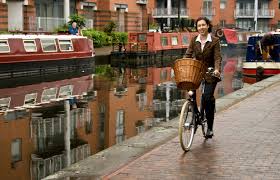
Momentum Editor Sarah Ripplinger riding along a canal in Birmingham, UK.

Colorful rows of bike seats line long racks. Bins filled to the top with all manner of shiny and polished flyers, side rods and seat noses checker the room. Loud booms, bangs and whizzing sounds fill the air as workers operate machines — some at least 50 years old — that churn out springs and sheets of metal or stamp nameplates and holes.

This is the Brooks England Ltd. factory where the well-known leather saddle and bike bag manufacturer produces comfortable and durable accessories and posterior supports for customers around the world.

Taking the saddles from flat leather mats to seats fit for the open road is a team effort, and the workers at the factory showed how it’s done to the close to 50 journalists from around the world who gathered there for a tour on June 8, 2010.

The factory, located in Smethwick, West Midlands, UK, is where it all happens: from cutting out the pattern of the saddle, to molding the shape of the seat and securing it with copper rivets.

Established in 1866, Brooks has a long history of fashioning saddles that presently cater to the sensibilities of traditionalists, everyday cyclists and performance riders alike.

The leather is sourced from farms in England where the cows roam in open pastures. Exposure to the elements makes their hides thicker and produces the required five-millimeter-thick leather Brooks demands for its saddles. The toughness of the leather is why Brooks saddles can last a lifetime.

After the saddle pattern is stamped out — cowhides used to make the leather seats come from the back and rump of a cow — the spare leather is used for accessories, such as leather grips and the ends of handlebars.

It’s a hands-on process: from soaking the leather to make it pliable, to molding it into the proper shape, smoothing the edges of the leather and affixing it to metal rails and springs. And it’s refreshing to see that Brooks is still producing quality saddles in this traditional manner.

A Very Merry Tweed Ride and Picnic

Our day wouldn’t have been complete without a cycle through the English countryside in our finest riding attire. The 2010 Extraordinary Brooks Picnic ride was a 17-mile jaunt from the Brooks factory, along the beautiful network of canals in Birmingham and over to Blackwell Court, the former Brooks family home.

It poured rain that morning, so many of us — including me — were furnished with Brooks’s new John Boultbee Oxford Rain Capes. The capes, which have reflective material woven into the fabric in certain places, kept my upper half perfectly dry and quite toasty. The cape comes with magnetic ties at the front that you hook over your handlebars — producing a tent that protects your legs and feet.

Inclement weather aside, we shared a lot of laughs, a couple of bumps and repairs and a lot of stories from our respective homes. The surrounding environment was a marvel to look at, with old brick and stone houses — some with thatched roofs — fields with grazing sheep and cows and brick lanes. Plus, I got to ride on the left-hand-side of the road, which was a thrilling experience along the narrow streets still dominated by the personal automobile.

I met some wonderful people from Brooks and other bicycling publications and got a taste of England, including fish and chips and bangers and mash. The ride and factory tour were certainly highlights of the trip. Not only good excuses to dress up, act the refined cyclist and test out some Brooks gear — including their saddles — for an afternoon, the trip was a reminder of the origins of cycling.

Bikes with pedals — known as velocipedes (fast feet) — have been ridden in Europe since the 1860s. While much has changed in the world of bikes since then, some things remain the same, such as handmade saddles and the warmth and moisture wicking properties of a good tweed jacket.

Originally published in Momentum magazine.